

Hockey Pool Guide
Independent guide · amounts in C$ · 19+
Hockey pool rules for Canadians: how office pools run from October to April, common mistakes, a step-by-step setup and how it differs from Royal Vegas
- Kahnawake permit holder
- C$1,200 welcome package
- 19+ in most provinces
Independent review site. Partner links open the operator's site in a new tab.
How hockey pools work in Canada
A hockey pool is a season-long game among friends, family or colleagues. Everyone picks a roster of NHL players, real goals and assists turn into pool points, and whoever finishes with the highest total takes the prize. In Canada the tradition is strongest in offices, where a shared spreadsheet and a group chat keep the banter going from the first puck drop in October until the final games in April. A separate playoff pool often follows in spring.
One thing is worth saying early: pools are organized by people, not by casinos. Royal Vegas is an online casino, so it does not run office pools, and this guide treats the pool as its own thing. What follows is a plain explanation of the rules people use, the slips that cause arguments and a clean way to set one up.
- 01
Full-season pool
Rosters are drafted before October and points are counted until April. It suits offices that like a long-running table and weekly bragging rights.
- 02
Playoff pool
Opens when the spring bracket is set. Participants pick players for each round, so it is quick to learn and easy for newcomers to join.
- 03
Weekly pool
Fresh picks every week, each with its own small prize. A good fit for groups who want less commitment than a full season.
- 04
Auction draft
Each entrant gets a budget and bids for players. It adds strategy and stops everyone from choosing the same handful of stars.
- Roster size and positions, for example forwards, defence and goalies.
- Scoring: how many points for a goal, an assist and a goalie win.
- The entry fee, who collects it and the date it is due.
- The prize split and what happens when totals are tied.
- Trade and replacement rules, plus the last day to change a roster.
- How points are tracked and who has the final word in a dispute.
Common hockey pool mistakes
Most pool arguments are not about hockey, they are about rules nobody wrote down. The mistakes below turn up in offices every year, and each one is cheap to avoid if you deal with it before the draft.
- Starting the draft without final scoring rules, then changing them after a rival's player has a big night.
- Letting one person hold the only copy of the standings, which makes honest mistakes look suspicious.
- Skipping an entry deadline, so people pay after the first games and expect the same prize.
- Having no replacement rule for a player who is out injured for months.
- Leaving tiebreakers undecided, then finding two people share first place and the pot will not divide cleanly.
- Mixing pool money with a personal account, which makes it hard to show where entries went.
Keep a pool at a stake everyone can happily lose. If you also play at a casino, keep the two budgets separate and use the deposit limits guide to set a ceiling you are comfortable with.
How to set up a hockey pool step by step
Pick the format
Decide between a full-season, playoff or weekly pool and choose a start date. For a full season that is usually early October.
Fix the headcount
Aim for 10 to 20 participants. Smaller groups make a thin prize pot and larger ones become slow to track.
Set the entry fee
Choose an amount nobody will mind losing, for example C$20, and agree on a date by which everyone has paid.
Write the scoring
One point per goal and per assist is the simplest approach. Add goalie points for wins and shutouts if you want netminders to matter.
Run the draft
Use a snake order, so the last pick of round one gets the first pick of round two. Record every roster in a shared sheet.
Publish the split
Announce the prize split and the tiebreaker before the first game and pin the message in the group chat.
Track and share
Update standings weekly, send a short table, and settle the payout soon after the final standings are confirmed.
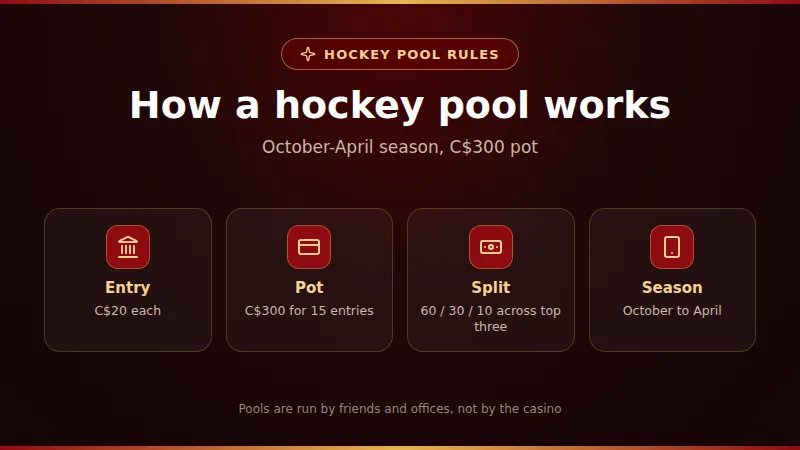
Money is the part people remember, so show it up front. Here is a simple example: 15 entries at C$20 make a C$300 pot, split 60/30/10 across the top three. That gives C$180 for first place, C$90 for second and C$30 for third. Whatever split you choose, post it in the group chat before the draft so nobody is surprised in April.
15 entries at C$20 each make a C$300 pot; 60%, 30% and 10% give C$180, C$90 and C$30
What players say about hockey pools
People who run pools describe them in similar terms. They like that a pool gives every game a reason to matter, even a Tuesday night between two teams nobody follows. They enjoy the group chat, the friendly rivalry with colleagues and the way a long season keeps a team of coworkers talking. Organizers add that a clear sheet of rules saves more time than any clever tool.
Many also point out that a pool is at its best when it stays small and social. A modest entry and written rules keep the conversation about the games rather than the money.
Strengths
- Easy to join, even for casual fans
- Makes regular season games more fun to follow
- Cheap and social when the entry stays small
Worth knowing
- Someone has to track points every week
- Tiebreakers need to be agreed in advance
- Late joiners need a clear rule
Before and after: a better-run pool
| Area | Before | After |
|---|---|---|
| Rules | Verbal | Written |
| Scoring | Changed mid-season | Fixed at draft |
| Standings | One person's file | Shared sheet |
| Entry fees | Collected loosely | Fixed deadline |
| Ties | Argued | Tiebreaker set |
| Payout | Announced late | Posted early |
| Injuries | Ignored | Replacement rule |
Each change costs a few minutes at the start and removes most of the disputes that spoil a pool by January. The point is not to make the pool formal, only to make sure everyone plays the same game.
Keeping pools and casino play separate
Royal Vegas is a place for casino play, and a hockey pool is a social contest, so there is no need to blend them. If you play in Canadian dollars, the Playing in CAD page covers that, the deposit guide walks through funding an account and the withdrawal guide explains how to cash out. If you like a leaderboard feel, the tournaments page shows what is on offer.
One Canadian detail: a credit card deposit counts as a cash advance, so check with your bank before using one. For pool entries, an e-Transfer to the organizer is the usual route and leaves a record that everyone can see.
If a pool or any other kind of play starts taking too much of your time or money, ConnexOntario and responsiblegambling.org offer support and information.
Hockey pool questions answered
When does a hockey pool season run?
Most full-season pools start in October, when the NHL regular season begins, and finish in April. A playoff pool usually follows in spring. Choose the start and end dates before the draft and share them with everyone so nobody is unsure when points stop counting.
How many points should a goal and an assist be worth?
Many pools give one point for each goal and each assist, then add points for goalie wins and shutouts. There is no single right answer. The best choice is whatever suits your group, as long as it is written down and agreed before the draft starts.
How much should the entry fee be?
Pick an amount nobody will worry about, such as C$20. A small fee keeps the pool a friendly game, and with about 15 people it still makes a pot that feels worth chasing. Collect it by a set date so everyone starts on equal terms.
Does Royal Vegas run hockey pools?
No. Royal Vegas is an online casino, and office hockey pools are organized by the group itself, usually with a shared spreadsheet and a trusted organizer. This guide simply explains how pools work so your own group can run one smoothly.
What happens if two players tie?
Agree on a tiebreaker before the draft. Common choices are most goals, most points in the final month, or splitting the prize evenly between the tied players. Posting the rule in the group chat early avoids arguments when the final table is published.
Can I join a pool in the middle of the season?
Only if your pool allows it. Some groups accept late entries with a roster drawn from players still available and a reduced fee, while others point newcomers to the playoff pool. Ask the organizer and agree on one rule so it stays fair for everyone.
Who should hold the pool money?
Ideally one trusted organizer, preferably someone who keeps a simple record of who has paid. Using e-Transfer leaves a trail, and posting the payout split before the first game keeps everyone confident about where the money goes.
Keep reading
Ready to see it for yourself?
Everything on this page describes the Canadian version of the casino: C$ wallet, C$10 minimum deposit and the four-part welcome package.

Welcome package
C$1,200
100% up to C$300 × 4 deposits · min. deposit C$10 · 35x (bonus)