

Royal Vegas How to Deposit
Minimum C$10 · Interac, cards and wallets · no fee from the casino
Nine payment methods reach the Canadian cashier, and they do not behave the same way. This page walks through each one, what it costs you at your own bank, how fast the money lands, and what to do on the evening a deposit will not go through.
- Interac e-Transfer
- C$10 minimum
- 19+ in most provinces
Independent review site. Partner links open the operator's site in a new tab.
How a Royal Vegas deposit shows up on your bank statement
Most of the anxiety around a first casino deposit is not about the money. It is about the line that turns up in online banking two days later, in front of whoever else looks at that account. So let us start at the end of the process rather than the beginning.
You press Deposit
The cashier asks for an amount and a method. The floor is C$10, the ceiling is whatever your bank or wallet allows, and the form refuses anything below the minimum before it ever contacts your bank.
The payment is authorised
A card goes out to Visa or Mastercard and comes back with a yes or a no in a couple of seconds. An Interac e-Transfer hands you off to your own bank login. A wallet asks you to confirm inside the wallet.
The balance moves
Deposits are credited instantly on every method in the Canadian cashier. If you claimed a part of the welcome package, the matching bonus lands at the same moment and starts its own seven-day clock.
The statement catches up
Your bank posts the transaction anywhere from the same evening to three business days later. Until it posts it may sit as a pending authorisation with a slightly different amount if any currency conversion was involved.
Now the part people actually want to know. The descriptor on a Canadian statement is set by the payment processor that handled the transaction, not by the casino and not by us, and processors rotate those strings more often than any guide can keep up with. What you can count on is the shape of it: a trading or processor name, often abbreviated, sometimes with a city or a country code attached, and a reference number. What you should not count on is a particular string, which is why there is no example descriptor printed on this page. If a review site shows you one in bold, treat it as a snapshot of one transaction on one day rather than a rule.
There are two practical consequences. The first is that you cannot identify the transaction by the word "casino", because it may not appear at all. Match it by amount and date instead, and keep the confirmation the cashier shows you. The second is that a Canadian card issuer does not need the descriptor to know what the payment is: the merchant category code travels with the transaction and tells the bank it is gambling before the descriptor is ever written. That matters more than the text, and it is the reason a card can be declined by a bank that has never seen the merchant before.
One more habit worth forming on day one. Screenshot or save the cashier confirmation for the first deposit on each method. It costs nothing, and it is the document that settles an argument later if a deposit posts twice, if an e-Transfer sits in limbo, or if verification asks you to prove that the account you are withdrawing to is the one you paid in from.
Deposits are instant. The delay you notice is your bank posting the transaction, not the casino crediting your balance — those are two different clocks and only the second one is under the casino's control.
Debit and credit cards
Visa and Mastercard are the default suggestion in every cashier in the world, and in Canada they are also the methods most likely to embarrass you at the checkout. It is worth understanding why before you reach for one.
A Canadian credit card does not treat a casino deposit as a purchase. Most issuers code it as a cash advance, which means three things happen at once: a flat fee is added on top of the amount, the interest-free grace period does not apply, and interest starts accruing from the day of the transaction at the cash-advance rate rather than the purchase rate. Deposit C$100 on a credit card and you have not spent C$100 — you have borrowed it, on the most expensive terms your card offers. If you carry a balance, that alone is a good reason to pick a different method.
On top of the cost, a meaningful number of Canadian issuers simply block the category. Some block it permanently as policy, some block it on a first attempt and let it through after you call them, and some allow it on a debit card while refusing it on a credit card from the same bank. None of that is visible from the cashier. From where you are sitting, the transaction just fails, which is why the decline section further down this page starts with your bank rather than with the casino.
Debit is the quieter option. A Visa Debit card draws on money you already have, so there is no cash-advance charge and no interest, and the transaction looks like an ordinary card payment to the merchant side. It is still routed over the card networks, so it can still be blocked, but it removes the borrowing problem entirely. If you want a card in the cashier and you have the choice, use the debit one.
Visa debit
Instant, no borrowing, and withdrawals can normally be sent back to it in three to five business days. The most sensible card choice for a Canadian player who does not want a wallet.
Visa credit
Works when the issuer allows it, but expect a cash-advance fee and interest from day one. Fine for a small, occasional deposit you clear immediately; expensive as a habit.
Mastercard
Behaves the same way as Visa in Canada, including the cash-advance treatment on credit. Acceptance varies by issuer rather than by network, so one bank refusing it says nothing about another.
Google Pay
A card in a different wrapper. The deposit is instant and the phone handles authentication, but the money and the limits still belong to the card sitting inside Google Pay, cash-advance treatment included.
Why people still pay by card
- Nothing to set up. No extra account, no registration, no waiting for a third party to verify you before your first C$10 goes in.
- The payout route is obvious. Withdrawals go back to the method you paid in from, and a card in your own name satisfies that rule without any thought.
- Verification is simpler. Proof of the payment method is a photo of a card you already own rather than a wallet statement you have to dig out.
- It is instant. A card deposit credits as fast as anything else in the cashier, so there is no speed penalty for choosing it.
What to keep an eye on
- Cash-advance pricing. A flat fee plus interest from the transaction date, on a credit card, every single time.
- Blocks you cannot see. The issuer makes the call and the cashier only sees the result, so a quick word with your bank usually settles it.
- Slow on the way out. Three to five business days back to a card, against hours for a wallet, on top of the pending period.
- Someone else's card is a dead end. A card in another name will fail verification later even if the deposit itself goes through today.
Every deposit method compared
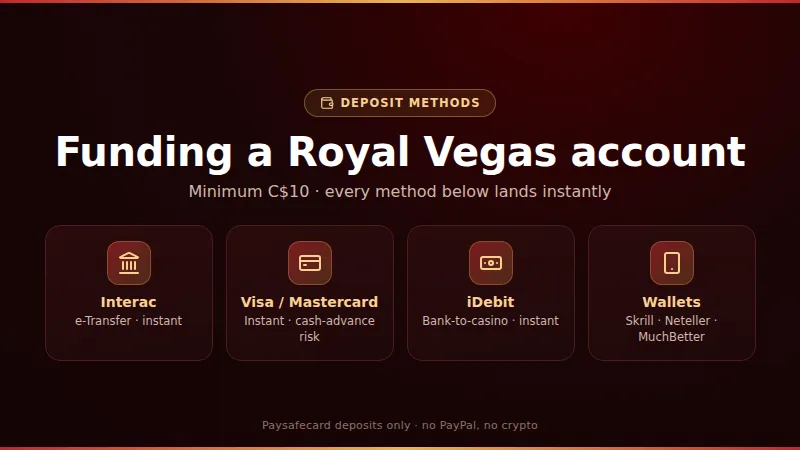
These are the nine Royal Vegas deposit methods a Canadian account actually sees. Minimums come from the cashier, ceilings come from your own bank or wallet rather than from the casino, and the last column is the one most people wish they had read first.
| Method | Minimum | Maximum | Speed | Fee from the casino | Withdraw back to it? |
|---|---|---|---|---|---|
| Interac e-Transfer | C$10 | Your bank's e-Transfer cap | Instant | None | Yes |
| iDebit | C$10 | Your online banking limit | Instant | None | Yes |
| Visa | C$10 | Set by your issuer | Instant | None | Yes, 3–5 business days |
| Mastercard | C$10 | Set by your issuer | Instant | None | Yes, 3–5 business days |
| Google Pay | C$10 | Limit of the card inside it | Instant | None | No — pick another method |
| Skrill | C$10 | Your wallet limit | Instant | None | Yes, fastest route out |
| Neteller | C$10 | Your wallet limit | Instant | None | Yes, fastest route out |
| MuchBetter | C$10 | Your wallet limit | Instant | None | Yes |
| Paysafecard | C$10 | Value of the voucher | Instant | None | No — deposit only |
Read the table in two passes. On the first pass, notice how little separates the methods on speed and cost: every one of them credits instantly and none of them carries a casino fee, so those two columns should not decide anything for you. On the second pass, read only the last column. That is where the methods genuinely differ, and it is the column that determines how your money comes back weeks later.
Paysafecard is the clearest example. It is a prepaid voucher you buy with cash at a Canadian retailer, which makes it excellent if you want a hard spending ceiling and no bank involvement at all. It is also deposit-only: there is no rail to send a payout back onto a used voucher. Deposit with it and you will have to nominate a second, verified method before you can withdraw anything, which means doing the verification work anyway, just later and under more pressure. The same logic applies to Google Pay, which has no payout rail of its own.
The maximum column deserves a word too. There is no published per-transaction deposit ceiling from the casino side, and any page quoting you a precise one is guessing. What actually stops a large deposit is your own bank: a daily e-Transfer cap, a card limit, or a wallet tier you have not upgraded. If a deposit for a larger amount fails while a small one succeeds, that is your limit talking, not the casino's.
- Minimum depositC$10
- Deposit speedInstant
- Casino deposit feeNone
- Methods in Canada9
E-wallets
Four wallets reach the Canadian cashier: Skrill, Neteller, MuchBetter and, if you count a prepaid voucher as a wallet, Paysafecard. They all solve the same two problems, and they all create the same small piece of extra work.
The first problem a wallet solves is the statement. When you fund a Skrill or Neteller balance, your bank sees a transfer to a regulated payments company, not a gambling merchant. Whether that matters to you is personal, but it is the reason a lot of Canadian players move to a wallet after a card gets blocked. The second problem it solves is speed on the way out. Withdrawals at Royal Vegas sit for a 24-hour pending period and then take roughly 48 hours to process, with no processing over the weekend. After that, a wallet payout lands in hours while a card payout takes another three to five business days. The wallet does not shorten the casino's clock; it shortens everything after it.
The extra work is that a wallet is a second account with its own verification, its own limits and, crucially, its own name on it. A Skrill account opened in a different name from your casino account is worthless here, because withdrawals go back to the deposit method and the payment-method proof has to match. Set the wallet up in your own name, verify it before you need it, and the rest of the process is smooth.
MuchBetter is the odd one out and worth a look if you deposit from a phone. It is built around a mobile app with its own authentication, which removes the browser redirect step entirely, and it supports payouts as well as deposits. Paysafecard, as noted above, does not. Neither does Google Pay, which is a card wrapper rather than a true wallet, however it is presented in the cashier.
Skrill
Instant in, and the quickest route out once the pending and processing periods are over. Fund it from a card or a bank transfer first; a wallet with a zero balance cannot deposit anything.
Neteller
Same operator, same behaviour, same speed. Having both is pointless — pick one, verify it properly and use it for deposits and payouts alike so the audit trail is a straight line.
MuchBetter
App-first, with authentication on the handset instead of a browser redirect. Works in both directions, which makes it a real alternative rather than a one-way convenience.
Paysafecard
Cash bought at a Canadian retailer, spent as a code. The hardest possible spending limit and no bank involvement — but no payouts, so you will need a second method eventually.
Currency matters
Hold your wallet balance in Canadian dollars. A wallet that converts from another currency on every deposit quietly charges you a spread that the casino never sees and cannot refund.
Name matching
Casino account, wallet and bank account should carry the same name and the same address. Every held payout story that ends badly starts with a mismatch in one of those three.
Before you fund a wallet specifically to claim a bonus, read the promotion terms in the cashier. Wallet exclusions on welcome offers are common across the industry, and the terms page attached to the offer is the only place that settles it for your account.
If a deposit does not go through
"Why was my deposit declined" is the most common question on this page, and the answer is unsatisfying but useful: in Canada, it is usually not the casino. Here are the causes in rough order of how often they turn out to be the real one.
Your bank blocks gambling
Canadian issuers can and do refuse the whole merchant category. Nothing about your account or the amount is wrong; the transaction never gets past your own bank. A different bank, or a different method entirely, is the fix.
No cash-advance room
If the issuer treats the deposit as a cash advance and your cash-advance limit is smaller than your credit limit — which it usually is — the payment fails even though the card is nowhere near maxed out.
A daily or per-transaction cap
Interac e-Transfer limits, card limits and wallet tiers all cap a single payment and a rolling day. A C$50 deposit succeeding after a C$500 one failed is the classic signature of this.
The name does not match
A card or wallet belonging to a partner, parent or employer will be refused, and if it slips through it will fail at verification later. Deposit only from something in your own name.
Wrong details, right card
An expired date, a mistyped CVV, or a billing address that no longer matches what the bank has on file. Boring, common, and fixed in thirty seconds once you think to check.
Method not offered to you
The cashier shows what is available for your account and your province. Ontario accounts are served under separate arrangements from the rest of Canada, and a method you read about elsewhere may simply not be on your list.
What you should not do is retry the same card six times. Repeated declines on a gambling merchant are exactly the pattern a fraud system is watching for, and the usual result is a temporary freeze on the card that takes a phone call to your bank to lift. Two attempts is plenty. If the second one fails, the answer is a different method, not a third attempt.
It is also worth separating a decline from a deposit that appears to have vanished. If money has left your account but the casino balance has not moved, that is not a decline — it is a pending authorisation or a transfer in flight. Card authorisations that fail after the hold is placed release on their own, usually within a few business days. An Interac e-Transfer that was sent but not claimed can sit for a while before it bounces back. In both cases the money comes back without anyone doing anything, and opening a dispute with your bank in the meantime tends to slow things down rather than speed them up.
Check the obvious first
Expiry date, CVV, billing address, and whether the amount is at least C$10. Then check whether a smaller amount goes through, which tells you immediately that you are hitting a limit rather than a block.
Switch the rail, not the card
If a card fails, do not try another card from the same bank. Move to Interac e-Transfer or a wallet, because those travel over different rails and are not subject to the same category block.
Ask the two parties in order
Your bank knows whether it declined the transaction and why, and it is the only one who can lift a block. If the bank says it approved the payment, that is the point to open the casino's 24/7 live chat, or call 1-866-745-2416, with the amount, the time and the method to hand.
Support cannot see your bank's reason for a decline, only that the attempt failed. Going to your own bank first turns a long conversation into a short one.
The banking rails behind the scenes
Three different systems move money into a Canadian casino account, and they fail in three different ways. Ten minutes understanding them saves a lot of guessing later.
The Interac rail. Interac e-Transfer is not a card network at all. It is a messaging layer on top of the Canadian banking system: your bank sends a notification, the recipient claims it, and the money moves between the two accounts through the normal payments infrastructure. Because no merchant category is involved, there is nothing for a card issuer to block, which is exactly why Interac is the method that keeps working when Visa and Mastercard have both said no. What can go wrong instead is a bank-side limit, a transfer sent but never claimed, or an e-Transfer allowance you have already used up for the day. Worth knowing: Interac Online, the older product where you were redirected to your bank's login to pay a merchant directly, was shut down on 31 May 2024. It no longer exists anywhere, and a guide still recommending it has not been touched in over two years.
The card rail. When you pay by Visa or Mastercard, the request runs from the casino's processor through the network to whichever Canadian bank issued your card, and that bank makes the decision. Attached to the request is a merchant category code — 7995 is the one used for betting and gambling transactions — and it is that code, not the descriptor text, that tells your issuer what it is looking at. The code is why an issuer can apply a blanket policy, why it can price the transaction as a cash advance, and why the decision is identical whether the merchant is a casino you have never heard of or a brand operating for two decades. It also explains something that confuses people: the casino genuinely does not know why your bank refused. All it receives back is a refusal.
The wallet rail. A wallet like Skrill, Neteller or MuchBetter sits between you and everyone else. You pre-fund it from a card or a bank transfer, and afterwards the casino deals only with the wallet. Because the wallet already holds your money, the deposit is a book entry rather than a request across a network, which is why wallet deposits are so reliable and why wallet payouts are the fastest way out. The trade-off is that the funding step still has to happen somewhere, and it can be blocked at that stage by the same Canadian issuer that was blocking direct deposits — a card block can follow you into the wallet if you fund the wallet with that card. Funding a wallet by bank transfer instead sidesteps it.
All three rails end at the same place: a C$ balance in your casino account. But they carry very different information back. The card rail gives you a yes or a no with nothing attached. Interac gives you a status you can see in your own online banking. A wallet gives you a transaction history in a third place that you control. When something goes wrong, the amount of evidence you can gather depends almost entirely on which rail you chose, and that is an underrated reason to prefer Interac or a wallet over a card.
None of this is specific to one casino. Royal Vegas is operated by Baytree Interactive Limited, a permit holder on the Kahnawake Gaming Commission list, and the brand also appears in the iGaming Ontario site directory for the Ontario market. The licensing tells you who is accountable for the account. It does not change how your bank treats a gambling transaction, which is a decision made entirely on your side of the wire.
- Interac railBank to bank
- Card railIssuer decides
- Wallet railPre-funded
- Payout clock24h + ~48h
What players say
Three notes from Canadian readers about depositing, kept because each one changed something on this page. Dates are the dates we received them.
"Interac e-Transfer is the one I keep coming back to: about a minute from my banking app to the casino balance, and the first 100% match was sitting there before I opened the lobby."
"Switching from the credit card to Interac was the best tip I picked up here — no cash-advance charge, the money lands instantly and the same method works when I want to be paid out."
"The table showing which methods also pay out is genuinely useful. I started with Skrill for that reason, and my first payout came back to the same wallet without any extra steps."
Good to know before you top up
Six things Canadian players believe about casino deposits that are either outdated, half-true, or copied from a page about a different market.
"A bigger first deposit gets a bigger bonus"
Only up to a point. The match is 100% of the deposit up to C$300 per deposit, across the first four. Anything above C$300 in one go is matched to C$300 and no further. Four deposits of C$300 collect the full C$1,200; one deposit of C$1,200 does not.
"You need a promo code"
Not here, and in Ontario promo codes are not used at all. If a page hands you a code for this casino, it is either recycled from another brand or invented outright. Deposit, opt in where the cashier asks you to, and the match applies.
"Crypto is faster, so use that"
There is no crypto option for Canadian players at Royal Vegas, and no PayPal either, however many review pages list them. The verified list is nine methods and it does not include either one.
"Interac Online is the Canadian way to pay"
It was, once. The product was shut down on 31 May 2024. What survives is Interac e-Transfer, which is a different mechanism with a different flow, and it is the one in the cashier today.
"The deposit is slow"
Deposits are instant on every method here. What is slow is the way out: a 24-hour pending period, roughly 48 hours of processing, nothing over the weekend, and a C$5,000 weekly ceiling. People remember the payout wait and misattribute it to the deposit.
"I can deposit on my partner's card"
You can sometimes get the payment through, and it will cost you later. Verification asks for proof of the payment method before the first withdrawal, and a card in another name fails that check with the money already in the account.
One genuine extra is worth mentioning because it is so often described wrongly. The first deposit credits 2,500 loyalty points to your account, and there is a Mega Millionaire Wheel offering ten daily spins alongside the personalised Daily Deals that appear once the account has some history. Those are real, and they are separate from the welcome match. What they are not is free spins on the welcome package — the standard Canadian package is four deposit matches and nothing else, and there is no no-deposit bonus to claim before you fund the account.
Finally, the minimum withdrawal. Reviews disagree about it: some quote C$10, others quote C$50, and the figure has evidently moved at some point without an announcement. We are not going to pick the prettier number. Assume C$50 when you plan a first payout and you will never be caught out, and check the cashier on the day, because that is the only version that counts.
Deposit FAQ — quick answers
What is the minimum deposit at Royal Vegas in Canada?
C$10. That is the floor on every method the Canadian cashier shows, and it is also the amount you need to trigger a part of the welcome package, which matches 100% of the deposit up to C$300 on each of your first four top-ups. A deposit under C$10 is simply refused by the form before it reaches your bank.
Can I deposit with Interac e-Transfer?
Yes. Interac e-Transfer is the method most Canadian players here use, and it is the one that usually survives when a card is blocked, because the money moves bank to bank rather than across the card networks. Note that Interac Online, the older browser-redirect product, was shut down on 31 May 2024, so any guide still telling you to pick it is out of date.
Why was my deposit declined?
In Canada the decline almost always comes from your bank rather than from the casino. Canadian issuers routinely block gambling merchants outright, and the ones that allow them often process the payment as a cash advance, which fails if you have no cash-advance room left. Other common causes are a card belonging to somebody else, a daily limit you have already hit, an expired card, or a payment method the casino cannot accept for your province.
Does Royal Vegas charge a fee to deposit?
The casino does not add a fee to a Canadian deposit on the methods listed in the cashier. Your own bank or wallet can still charge you: a credit card treated as a cash advance carries a flat fee plus interest from day one, some banks charge for an outgoing Interac e-Transfer once you pass their free allowance, and a wallet may take a cut when it converts another currency into C$.
Can I deposit with PayPal or Bitcoin?
No. Neither PayPal nor cryptocurrency is available to Canadian players at Royal Vegas, whatever an older review page says. The verified Canadian list is Visa, Mastercard, Interac e-Transfer, iDebit, Paysafecard, Skrill, Neteller, MuchBetter and Google Pay. If a method is not in that list, do not plan your deposit around it.
Do I have to verify my account before I can deposit?
You can usually deposit and play first, but verification is required before the first withdrawal, so there is no point putting it off. Have a photo ID, a proof of address and a proof of the payment method ready. Depositing from a method that is in your own name is what makes that last document easy, and it is the single biggest cause of held payouts when it goes wrong.
Keep reading
Ready to see it for yourself?
Everything on this page describes the Canadian version of the casino: C$ wallet, C$10 minimum deposit and the four-part welcome package.

Welcome package
C$1,200
100% up to C$300 × 4 deposits · min. deposit C$10 · 35x (bonus)